Availability and information about some of the books written by Ann Savours.
 |
 |
|
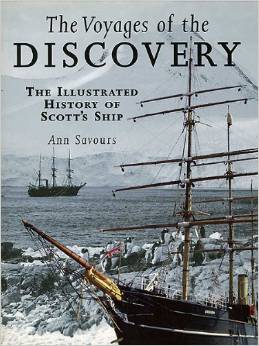
The Voyages of the Discovery Published in 1992. |
The Voyages of the Discovery [abridged version 1992] Built in 1900 for Captain Scott’s Antarctic expedition of 1901, Discovery‘s dramatic life spans a century of adventure, exploration and danger. This book portrays the heroism and determination of the explorers and scientist who sailed in her to meet the challenge of the unknown. Confronting the turbulent Southern ocean, or wintering inshore with Discovery locked in eight feet of ice, the stories of their struggles almost eclipses the importance of their pioneering works. Discovery‘s subsequent history was just as eventful. After her expedition to the Antarctic, the Hudson Bay company used her as its annual supply ship from London. During World War I she ferried vital food and supplies to the Atlantic ports of France, and in 1915 she made a hazardous voyage to Archangel in north Russia to transport munitions to the Eastern Front. In 1916 she was sent south once more in a dramatic bid by the Admiralty to rescue Shackleton’s men, marooned on Elephant Island after the sinking of Endurance. She is now in Dundee, having been fully restored. Published in 2000. Click here to order the paperback Click here to order the ebook |
 |
 |
| Scott’s Last Voyage This book retells the story of Scott’s last expedition — the British Antarctic (Terra Nova) expedition, 1910-13—during which Captain Scott and his four companions died on their return journey from South Pole. Herbert Ponting was the ‘camera artist’ of the expedition, and his photographs supply a marvellous record of this epic of exploration. They portray the Antarctic in all its breathtaking beauty, the fascinating wild life, the explorers themselves and the daily life aboard the Terra Nova and at base. Ponting’s activities inspired the invention of a new word by one of his companions on the expedition —to ‘pont’, meaning to ‘pose’ until nearly frozen, in all sorts of uncomfortable positions’ for photographs. Ponting’s work as photographer in the Antarctic still stands supreme. Cherry-Garrard, author of The Worst Journey in the World, wrote ‘He came to do a job, he did it and did it well. Here in these pictures is beauty linked to tragedy—and the beauty is inconceivable for it is endless and runs to eternity.’ Published in 1974. Out of print. |
Third Edition The expeditions which headed north into the unknown wastes of the Arctic did so in defiance of terrible odds, and the names of those who led them – Frobisher, Cook, Hudson, Davis, Baffin, Parry, Ross and Franklin himself – are central to the mythology of European exploration. This new book tells the story of their remarkable feats and describes how the vast tracts of the ice-bound archipelago were slowly and painfully charted. It portrays the encounters with the Esquimaux and examines their vital help; it describes the boats and ships and the food and clothing on which the explorers depended as well as the alien habitat in which they found themselves. Based largely on the narratives, diaries and letters of the explorers themselves and containing illustrations never previously published, this work is a fitting testimony to the bravery and resourcefulness of men who lived in a harder and more uncertain time than our own. Published in 1999. Out of print. |
 |
| The South Polar Times: Volume IV: With the First Facsimile of the South Polar Times The South Polar Times was a magazine created by members of Captain Scott’s two expeditions to entertain themselves during the four months of Antarctic winter. Typed up, and illustrated with paintings, sketches and photographs, each issue was read aloud to all hands. They contain a mixture of the ‘grave and gay’, serious reports on the weather or fauna interspersed with cartoons, songs and articles that poke fun at members of the expedition. Together the material gives us an unsurpassed sense of their community.There were four volumes in all (two expeditions with two winters) each with four issues. The original Volumes 1 and II from the Discovery expedition were given to the Royal Geographical Society and were both published in 1907 (250 copies of each), but after the Terra Nova expedition only Volume III was published (300 copies) in 1914. The original is in the British Library along with Scott’s diary. Volumes I, II and III were republished in 2002. The manuscript for Volume IV is held in the Scott Polar Research Institute and was published for the first time in 2010 by John Bonham, in an edition uniform with the 2002 set, with Ann Savours’ masterly introduction to all four volumes.Available from the Scott Polar Institute |
 Ann Savours